Listeria monocytogenes is a bad bug. It is the third leading cause of death from food poisoning in the United States. People who are pregnant, elderly, or have a weakened immune system due to an underlying medical condition have a higher risk of serious illness and death from a Listeria infection.
It is our job to help protect the public and our loved ones from a Listeria infection through the effective execution of our sanitation programs all year round, but especially during “Listeria season”.
Listeria season is the time of year when outside conditions enable Listeria to grow better and faster. These outside conditions are temperature and water resources. Warmer weather and higher humidity breeds condensation issues in food facilities. Condensation becomes a water source for Listeria and other microbes, which can lead to microbial problems in the plant.
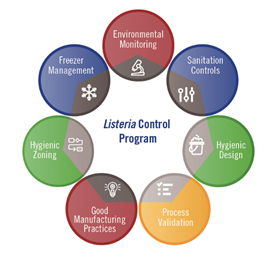
Removing condensation is a sanitation control, and it is just one piece of a larger Listeria control program. As the diagram below shows, in addition to sanitation controls, managing Listeria also requires environmental monitoring, hygienic design, process validation, good manufacturing practices, hygienic zoning, and freezer/cooler management. All these elements are needed to keep Listeria at bay and to stop it from entering the food supply.
Photo credit American Frozen Food Institute
We contribute to Listeria control through our sanitation efforts. Even with a superior sanitation program, plant environments are not sterile. Listeria monocytogenes is very widespread in nature, which makes it likely to be introduced into food facilities. Once Listeria enters the plant, it has properties that allow it to survive and compete with other microbes. By being able to grow at refrigeration temperatures, Listeria has the upper hand compared to organisms that cannot. Other survival advantages include being resistant to freezing and tolerating high salt conditions; it can also adapt to stresses, such as heat or acidity, in the production setting.
Because Listeria is skilled at surviving in production facilities, it can ultimately contaminate food and cause people to get seriously ill or even die. Listeria is a public health threat. During Listeria season we must work in partnership to double down on our efforts to prevent and remove Listeria from the plant environment
Food Guardian eNewsletter
Sign up to get exclusive news in your inbox every month.